
What Type of Tool Is a Porta Power? Uses, Parts, Working Process, and Safety Guide

If you have ever worked in an auto body shop, repair garage, fabrication shop, or industrial maintenance facility, you may have seen a compact hydraulic kit capable of producing a surprising amount of force. That tool is commonly known as a Porta Power.
So, what type of tool is a Porta Power? A Porta Power is a portable hydraulic tool system designed to apply controlled force for pushing, spreading, pressing, straightening, bending, and positioning heavy components. Depending on the design and attachments, certain hydraulic systems may also assist with other force-related jobs, but they should always be used only for tasks approved by the manufacturer.
Unlike a basic hand tool, a Porta Power uses hydraulic pressure to multiply the force applied by the operator. This means a relatively small manual input can create several tons of pushing force.
Porta Power kits are especially common in automotive collision repair. Technicians use them to move damaged metal, straighten vehicle structures, create space between components, and reposition parts that cannot easily be moved by hand. They are also useful in construction, fabrication, machinery repair, agricultural equipment maintenance, and other industrial settings.
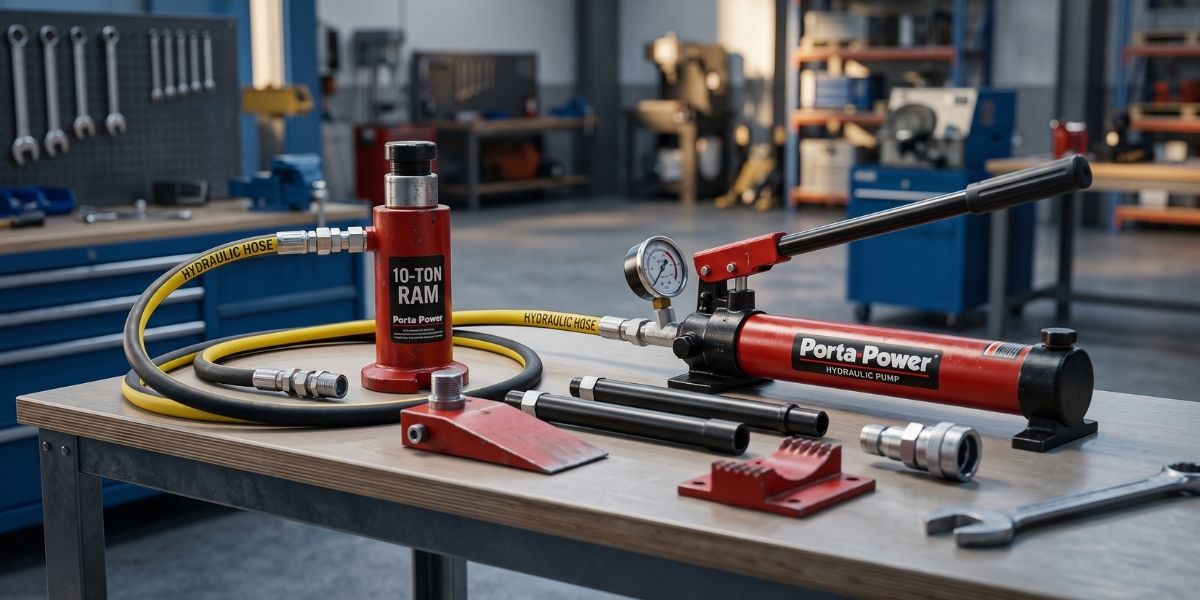
A typical kit includes a hydraulic pump, hose, ram or cylinder, extension tubes, bases, saddles, and different heads or attachments. The exact components depend on the kit and its rated capacity.
This guide explains what a Porta Power is, how it works, what it is used for, how it compares with hydraulic jacks and come-alongs, and what you should know before choosing or operating one.
What Type of Tool Is a Porta Power?
A Porta Power is a portable hydraulic pushing, spreading, and pressing system.
The term is often used to describe hydraulic body repair kits that include a hand-operated hydraulic pump connected to a hydraulic ram by a high-pressure hose. Different attachments can then be connected to the ram so that force can be applied in different positions.
Porto-Power is also associated with Blackhawk Automotive products, where the name is used for hydraulic body repair equipment. Blackhawk describes its Bosch 2.25 HP Plunge and Fixed-Base Router kits as tools intended for pushing, spreading, and pressing vehicle body panels, components, and assemblies.
The hydraulic design is what separates a Porta Power from conventional hand tools.
For example, if you try to straighten a damaged metal structure using only a pry bar, most of the force has to come directly from your body. With a Porta Power, the operator pumps a handle. That action pressurizes hydraulic fluid, and the pressure acts on a piston inside the cylinder.
The result is much greater output force.
This makes the tool useful when heavy parts must be moved slowly and in a controlled way.
Another major advantage is positioning. A conventional jack normally pushes vertically from underneath a load. A Porta Power ram may be positioned horizontally, vertically, or at another suitable angle when the manufacturer and setup allow it.
This flexibility is one reason the tool became popular in collision repair and metal straightening.
However, the ability to generate large amounts of force also creates risk. Hydraulic equipment should never be treated like an ordinary hand tool. The operator must understand the rated capacity, attachment limits, load position, hose condition, and safe operating procedure before applying pressure.
How Does a Porta Power Work?
A Porta Power works according to the basic principles of hydraulics.
Liquids are difficult to compress. Because of this property, hydraulic fluid can transfer pressure efficiently through a closed system.
A basic Porta Power setup contains:
- A hydraulic pump
- Hydraulic fluid
- A high-pressure hose
- A hydraulic cylinder or ram
- A piston
- A release mechanism
- Appropriate attachments
When the operator moves the pump handle, the pump moves hydraulic fluid through the hose toward the cylinder.
Pressure builds inside the cylinder.
That pressure acts against the piston. As the piston moves, the ram extends and applies force against the object being repaired or repositioned.
The amount of force available depends on factors such as hydraulic pressure, piston area, system design, attachment arrangement, and the rated capacity of the equipment.
Hydraulic Pump Operation
The pump is the starting point of the hydraulic system.
In a manually operated Porta Power, the user moves a pump handle repeatedly. Each stroke moves hydraulic fluid through the system.
One of the useful features of hydraulics is that the operator does not need to generate the entire output force directly. The hydraulic system converts the pumping What Type of Tool Is A Porta Power? action into pressure acting over the surface area of the piston.
As the pressure increases, the ram can produce substantial pushing force.
It is still important to remember that pumping harder does not mean the tool can safely exceed its rating. Every pump, hose, coupling, ram, extension, and attachment has operating limits.
The Role of Hydraulic Fluid
Hydraulic fluid transfers energy through the system.
When the pump moves fluid into the cylinder, pressure forces the piston outward.
A correctly maintained hydraulic system should contain the correct type and quantity of fluid specified by the manufacturer. Low fluid, contaminated fluid, trapped air, worn seals, or leaks can affect performance.
Air inside a hydraulic system can also cause irregular operation because air compresses much more easily than hydraulic fluid.
For this reason, manufacturers may specify procedures for purging air from their systems.
Always follow the instructions for the exact model rather than assuming that every hydraulic kit is serviced in the same way.
How the Hydraulic Ram Moves
The hydraulic ram is the part that physically applies force.
As fluid pressure acts on the piston, the piston rod extends from the cylinder. An attachment at the end of the ram then contacts the workpiece.
The force should be applied as directly and evenly as possible.
Poor alignment can create dangerous side loading. Instead of the ram pushing straight through its designed axis, sideways force may act on the cylinder, extensions, or attachments.
That can reduce stability and may damage the equipment.
How the Ram Retracts
After the required movement has been completed, pressure must be released according to the manufacturer’s instructions.
On many manually operated systems, opening a release valve allows the hydraulic fluid to return toward the pump reservoir. The ram can then retract.
The exact process varies by design.
Never disconnect a hydraulic hose or coupling simply to release pressure. The system should be depressurized through the intended control mechanism before hoses or attachments are handled.
Main Parts of a Porta Power Kit
A Porta Power is usually sold as a kit rather than as one individual tool.
The combination of components makes the system versatile.
Although kits vary by manufacturer, most contain several common parts.
Hydraulic Pump
The hydraulic pump creates fluid pressure.
Manual pumps are common in portable automotive repair kits because they are compact and do not require electricity.
The operator moves the pump handle to send hydraulic fluid through the hose and toward the ram.
Larger professional hydraulic systems may use air-powered, electric, or other types of pumps, but the basic principle is similar.
The pump should always be compatible with the pressure requirements of the cylinder, hose, couplings, and attachments.
Hydraulic Ram or Cylinder
The hydraulic ram converts fluid pressure into mechanical force.
It contains a piston that moves when hydraulic pressure enters the cylinder.
The ram is one of the most important components because its rated capacity helps determine how much force the system can safely produce.
Common portable automotive body repair kits are available in capacities such as 4 tons and 10 tons.
For example, Blackhawk lists 4-ton and 10-ton Porto-Power body repair kits. Its published specifications show different operating pressures for the two systems, demonstrating why pressure should not be assumed simply from the general name of the tool.
Hydraulic Hose
The hydraulic hose connects the pump with the ram.
Its job is to carry pressurized hydraulic fluid safely between the two components.
Although a hose may look simple, it operates under significant pressure. Damage such as cracks, bulges, severe abrasion, leaks, damaged fittings, or kinks should never be ignored.
OSHA inspection guidance for hydraulic equipment specifically identifies pressurized hoses and fittings as components that should be checked for leaks, deformation, abrasion, and other signs of deterioration.
Never grab or touch a suspected high-pressure leak with your bare hand.
The correct response is to stop using the equipment, release pressure safely, and follow the manufacturer’s inspection or repair procedure.
Extension Tubes
Extension tubes increase the working reach of the ram.
Imagine that a technician needs to push two sections of a damaged vehicle structure apart, but the standard ram cannot reach both contact points. An extension tube can help bridge the distance.
However, extensions do not automatically maintain the full capacity of the basic ram.
Some manufacturers substantially reduce allowable capacity when certain extensions or offset attachments are installed. One Blackhawk manual, for example, states that the rated capacity is reduced when extension tubes or offset attachments are used.
This is an important lesson: never assume a “10-ton kit” can deliver 10 tons through every possible attachment configuration.
Check the load chart and instructions for the exact setup.
Spreader and Attachments
A Porta Power kit may include several attachments designed for different jobs.
Common examples include:
- Flat bases
- Serrated saddles
- Wedge heads
- Ram toes
- Plunger toes
- V-shaped bases
- Rubber heads
- Spreaders
A spreader is useful when two components need to be separated.
A flat base can provide a broader contact point.
A V-shaped attachment may help position the system against certain shapes.
The purpose of these accessories is to allow controlled hydraulic force to be applied to different surfaces and configurations.
The attachment must still be properly seated and rated for the intended load.
What Is a Porta Power Used For?
A Porta Power is mainly used when a technician needs powerful, controlled movement in an area where ordinary hand tools are not effective.
Its most familiar use is automotive body repair, but its applications extend beyond cars.
Straightening Vehicle Frames and Structural Parts
Collision damage can move vehicle components away from their correct position.
A properly selected hydraulic repair system may be used as part of the process of pushing or repositioning damaged areas.
Modern vehicle structural repairs can be complex, however. High-strength steels, aluminum structures, advanced joining methods, sensors, battery systems, and manufacturer-specific repair procedures mean that simply “pushing a frame straight” is not always an acceptable repair.
Professional collision technicians should follow the vehicle manufacturer’s repair information and use appropriate measuring and repair equipment.
Moving Damaged Body Panels
A crushed or pushed-in body section may need force from the opposite direction before final panel repair can take place.
A Porta Power can create a slow, controlled push.
This may give technicians more control than striking the panel repeatedly with a hammer or attempting to force it with a long pry bar.
Separating Components
The tool can also create space between damaged components.
A spreader attachment may help separate metal sections that have been forced together.
This can be useful during collision repair, equipment maintenance, and certain fabrication jobs.
Aligning Machinery
In industrial or workshop environments, hydraulic rams may assist with positioning or aligning heavy components.
The operator can apply force gradually rather than trying to move the component suddenly.
This can be useful when fitting or repositioning machinery, but the operator must always know where the load will move as pressure is applied.
Bending or Repositioning Metal
Fabricators and repair technicians may use hydraulic force to reposition suitable metal components.
A Porta Power is not a substitute for every type of hydraulic press or bending machine, but its portability makes it useful for jobs that cannot easily be brought to a fixed shop press.
Construction and Maintenance Work
Portable hydraulic rams can also be useful in some construction and maintenance situations.
The system may help with alignment, positioning, spreading, or controlled movement of suitable structures or equipment.
The manufacturer must approve the intended application, especially when a load could fall or shift.
Heavy-Equipment Repair
Farm equipment, trailers, construction machinery, and other heavy equipment sometimes contain damaged parts that require controlled force for alignment or removal.
Portable hydraulic equipment can be useful because it can be carried to the machine rather than requiring the entire machine to be placed in a stationary press.
Again, blocking and support are critical. Hydraulic pressure should never be treated as a substitute for a proper mechanical support system.
Porta Power Uses in Automotive Repair
Automotive repair is probably the application most closely associated with Porta Power kits.
Their compact size and range of attachments can make them useful when repairing collision damage.
Vehicle Frame Straightening
After a collision, parts of a vehicle’s structure may become distorted.
A technician may use hydraulic force as part of a controlled straightening process.
However, repair should not be based only on visual appearance. Professional collision repair often involves measuring equipment, vehicle manufacturer specifications, controlled pulling or pushing, and repeated measurements.
The goal is not simply to make a damaged area look straight.
The repaired structure must meet acceptable dimensions and repair requirements.
Body Panel Repair
A Porta Power can also help move a damaged body panel from behind.
For example, if a large metal section has been pushed inward, the technician may be able to place the ram behind the damaged area and apply gradual pressure.
This does not replace normal metal-finishing techniques. Instead, it can complete the larger movement before more detailed repair begins.
Controlled force is usually better than sudden force.
Moving metal too far or too quickly can create additional distortion.
Moving or Aligning Components
Certain repair jobs require a component to move only a small distance so it can be aligned, removed, or installed.
A hydraulic ram can be valuable in these situations.
Unlike a pry bar, which depends heavily on leverage and operator strength, a Porta Power allows pressure to increase gradually.
This can give the technician more control.
The contact surfaces must still be strong enough to accept the force. Pushing against a weak panel, unsupported component, fuel system component, battery enclosure, or fragile casting can create serious damage.
Is a Porta Power a Hydraulic Jack?
A Porta Power and a hydraulic jack use similar principles, but they are not exactly the same type of tool.
Both rely on hydraulic pressure to multiply force.
Both typically contain hydraulic fluid, a pump, a cylinder, and a piston.
The difference is mainly in their intended function and configuration.
A conventional floor jack or bottle jack is primarily designed to raise a load from underneath at approved lifting points.
A Porta Power is more commonly designed to push, spread, press, straighten, or reposition objects from different directions.
Its detachable hose and variety of accessories give it greater flexibility for repair work.
Therefore, calling a Porta Power simply a “hydraulic jack” does not fully describe what the system does.
It is more accurate to call it a portable hydraulic body repair or pushing system.
It is also important not to assume that a Porta Power can replace a jack simply because both use hydraulics.
If the manufacturer has not approved a particular setup for lifting, do not use it as a lifting device.
Porta Power vs. Hydraulic Jack
Although both tools operate hydraulically, they serve different purposes.
FeaturePorta PowerHydraulic Jack
Primary purpose Pushing, spreading, pressing, straightening Raising loads
Typical force direction Multiple positions depending on setup Mainly upward
Common applications Body repair, alignment, fabrication, maintenance Vehicle and equipment lifting
Attachments Usually several interchangeable attachments Usually limited
Portability Portable kit with separate components Usually one main unit
Flexibility High Moderate
Typical automotive use Collision and body repair Raising vehicles
Load support Should not be treated as permanent support Also requires proper stands/support after lifting
A hydraulic jack is the better choice when the primary task is raising a vehicle from a manufacturer-approved lifting point.
A Porta Power is usually better when the job requires controlled pushing or spreading in a confined or unusual position.
Neither should be used as permanent support for a suspended load.
Once a load is raised or moved into a position where falling or shifting could cause injury, appropriate mechanical support and approved procedures should be used.
Porta Power vs. Come-Along
A Porta Power and a come-along can both move heavy objects, but they do so in very different ways.
A Porta Power usually pushes by hydraulic force.
A come-along usually pulls using a mechanical ratchet, cable, wire rope, or chain arrangement.
This basic difference determines which tool is more suitable.
Imagine that two bent components need to be pushed apart from the inside. A hydraulic ram may be the natural choice.
Now imagine that a damaged part needs to be pulled toward a secure anchor point. A properly rated pulling tool may be more appropriate.
A Porta Power also tends to work well where slow, strong pressure is needed within a short working distance.
A come-along can provide pulling movement across a longer distance, depending on its design.
Never improvise by turning a pushing tool into a pulling tool or a pulling tool into a pushing tool unless the equipment is specifically designed for that configuration.
Common Porta Power Sizes and Capacities
Porta Power kits are available in different capacities.
Two common sizes in automotive work are 4-ton and 10-ton kits.
The correct size depends on the task, working space, component strength, and required force.
4-Ton Porta Power
A 4-ton kit is often suitable for lighter automotive body repair and smaller positioning jobs.
Its advantages can include:
- Lower weight
- Easier transportation
- Compact size
- Easier positioning in restricted areas
- Adequate force for many lighter repairs
A lower capacity is not automatically a disadvantage.
Using a very large hydraulic system for a small job can make controlled movement more difficult if the operator is inexperienced.
The best tool is the one that provides the required force while remaining suitable for the application.
10-Ton Porta Power
A 10-ton Porta Power is common in professional workshops because it provides more available pushing capacity.
It may be used for heavier body repair, structural positioning, equipment repair, and other demanding tasks.
One Blackhawk 10-ton body repair kit is rated at 10,000 PSI, while its 4-ton version is listed at 8,000 PSI.
That example is important because tonnage and hydraulic pressure are related but are not the same measurement.
Tonnage describes force.
PSI describes pressure.
The piston area and system design help determine how hydraulic pressure is converted into output force.
Higher-Capacity Hydraulic Kits
Industrial hydraulic systems can provide capacities well beyond 10 tons.
These systems may be used for machinery maintenance, heavy equipment, construction, manufacturing, bridge work, or industrial positioning.
However, greater capacity also means greater stored energy and potentially greater consequences when something fails.
High-capacity hydraulic equipment should be selected and operated by people who understand the system, load path, support requirements, and manufacturer instructions.
How to Use a Porta Power Safely
Safety is one of the most important parts of working with any hydraulic tool.
A Porta Power may appear simple because the operator only pumps a handle. In reality, the system can create several tons of force and substantial hydraulic pressure.
Improper positioning, damaged equipment, overloaded attachments, or unexpected load movement can cause severe injury.
Inspect the Equipment Before Use
Check the complete system before applying pressure.
Look at:
- Hydraulic hoses
- Couplings
- Ram
- Pump
- Attachments
- Extension tubes
- Bases
- Seals
- Connecting threads
- Contact surfaces
Do not use equipment that appears bent, cracked, badly worn, leaking, or otherwise damaged.
OSHA guidance for hydraulic equipment emphasizes inspecting pressurized lines for deterioration and leakage and checking hoses and fittings for deformation, abrasion, or signs of failure.
Use the Correct Attachment
Choose the attachment designed for the type of contact required.
An incorrect attachment may slip when pressure increases.
Make sure the attachment is properly installed and seated before pumping.
Do not create homemade extensions, weld modifications onto hydraulic components, or combine incompatible parts unless an approved engineering procedure and manufacturer guidance allow it.
Keep the Ram Properly Aligned
The force should travel through the intended axis of the ram.
Side loading can create instability and stress parts that were designed mainly for straight-line force.
If the setup begins to bend, twist, shift, or tilt, stop.
Release pressure safely and reposition the system.
Use Stable Contact Points
Both ends of the hydraulic setup need strong, stable contact surfaces.
A powerful ram pushing against thin sheet metal may simply crush the contact point rather than move the intended component.
Technicians may use suitable bases or other approved methods to distribute load.
Never Exceed Rated Capacity
Do not assume that every component in a kit has the same rating.
The ram may have one rating while the spreader, extension arrangement, or attachment has a lower allowable load.
Manufacturers may also reduce capacity when extensions are added.
Check the instructions and load chart before use.
Keep Your Body Away From the Force Path
Never place your head, hands, feet, or body directly in line with a loaded hydraulic ram or attachment.
Think about what could happen if:
- The attachment slips
- The base breaks
- The workpiece suddenly moves
- A coupling fails
- An extension buckles
- The ram shifts sideways
High-pressure hydraulic failures can be extremely serious. OSHA accident records include fatal incidents involving failed hydraulic components and released parts, illustrating why hydraulic systems should be treated with great care.
Wear Appropriate Personal Protective Equipment
Suitable PPE may include safety glasses or face protection, protective footwear, gloves appropriate to the task, and other equipment required by the workplace.
PPE does not make an unsafe hydraulic setup safe.
It provides an additional layer of protection after correct equipment selection, inspection, positioning, and operating procedures are already in place.
Never Rely on Hydraulic Pressure as Your Only Support
If a component could fall, collapse, rotate, or shift after being moved, use an appropriate mechanical support or blocking system.
Do not place yourself underneath a load that is supported only by hydraulic pressure.
Advantages of Using a Porta Power
The popularity of Porta Power systems comes from their combination of force, portability, and flexibility.
High Force From a Compact Tool
A relatively compact hydraulic cylinder can generate several tons of force.
This makes the system useful when human strength or ordinary hand tools are not enough.
Portable Design
Unlike a large shop press, a Porta Power can be transported to the workpiece.
This is valuable when repairing vehicles, machinery, agricultural equipment, or structures that cannot easily be moved.
Multiple Attachments
One kit may handle several types of jobs.
By changing the base, saddle, spreader, extension, or contact head, technicians can adapt the system to different working positions.
Controlled Movement
Hydraulic force can be applied gradually.
This gives the operator an opportunity to monitor movement while pressure increases.
In collision repair, a controlled movement of a few millimeters can sometimes be more useful than a sudden large movement.
Useful in Confined Areas
The remote pump and hose arrangement allow the ram to fit into areas where a conventional jack or large press would be difficult to position.
Wide Range of Applications
A Porta Power can support work in automotive repair, fabrication, maintenance, construction, and equipment service.
Its versatility is one of its biggest strengths.
Limitations of a Porta Power
A Porta Power is useful, but it is not the correct answer for every force-related job.
Correct Positioning Can Be Difficult
A ram needs stable contact points.
In irregular structures, finding two suitable surfaces can be challenging.
A poorly positioned tool may slip as pressure increases.
Hydraulic Systems Require Maintenance
Seals, hoses, couplings, fluid, and pumps can wear.
Leaks may reduce performance and can also create safety concerns.
Improper Use Can Damage the Workpiece
Hydraulic force is powerful.
Applying several tons of force to the wrong point can bend a component that was not damaged before the repair began.
Capacity Changes With Some Setups
Extensions and attachments may reduce allowable load.
This can surprise users who assume the tonnage printed on the case applies to every configuration.
It Is Not a Universal Lifting Tool
A Porta Power should not automatically be treated as a replacement for a floor jack, bottle jack, vehicle lift, crane, or other equipment specifically designed for lifting.
Use the tool only for applications approved by its manufacturer.
It Usually Pushes Better Than It Pulls
The conventional hydraulic ram configuration is naturally suited to pushing.
When a job requires pulling over a long distance, a come-along, frame machine, hydraulic puller, or another rated device may be more appropriate.
How to Choose the Right Porta Power
Choosing a Porta Power should involve more than comparing prices.
The correct kit should match your actual work.
Determine the Required Capacity
Think about the heaviest jobs you realistically expect to perform.
A 4-ton system may be sufficient for lighter bodywork.
A 10-ton kit can provide greater capacity for more demanding repairs.
For industrial work, a specialized hydraulic system may be required.
Do not buy a higher-capacity tool simply because the number sounds better. Greater available force does not eliminate the need for control and correct setup.
Consider the Intended Application
Ask what you will actually use the tool for.
Will you be:
- Repairing vehicle body panels?
- Moving structural components?
- Working on farm equipment?
- Aligning machinery?
- Performing fabrication work?
Different applications may require different ram sizes, strokes, extensions, attachments, and pump arrangements.
Check Ram Stroke and Working Range
Ram stroke tells you how far the piston can extend.
A high-capacity ram with very short travel may not suit a job that requires greater movement.
Extension tubes can increase reach, but they must be used within manufacturer limits.
Check Hose Length
A longer hose may make pump positioning easier.
This can allow the operator to remain farther away from the immediate work area.
However, only use hoses approved for the pressure and system.
Never replace a hydraulic hose with an ordinary hose.
Review Included Attachments
Two kits with the same tonnage may contain very different accessories.
Check whether the kit contains the saddles, bases, extensions, spreader, heads, and adapters you expect to use.
Buying a complete system from the beginning may be more practical than trying to combine unrelated parts later.
Look at Build Quality and Documentation
A hydraulic tool is not a product where vague specifications are desirable.
Look for clear information about:
- Rated capacity
- Maximum pressure
- Operating instructions
- Attachment limits
- Replacement parts
- Maintenance procedures
- Manufacturer support
Clear documentation helps the operator understand how the tool should be used.
Consider Replacement Parts
Hydraulic seals, hoses, couplers, and other components may eventually require service.
A tool that has available replacement parts and technical support may provide better long-term value than an inexpensive kit with no service information.
FAQs
What Type of Tool Is a Porta Power?
A Porta Power is a portable hydraulic tool system used primarily for pushing, spreading, pressing, straightening, and repositioning components.
It normally includes a hydraulic pump, high-pressure hose, ram or cylinder, and several attachments.
It is commonly associated with automotive body repair but can also be used for certain fabrication, construction, machinery, and maintenance applications.
Is a Porta Power a Hydraulic Tool?
Yes.
A Porta Power is a hydraulic tool because it uses pressurized hydraulic fluid to operate a cylinder or ram.
The hydraulic system multiplies the operator’s input and produces much greater mechanical force at the ram.
What Is a 10-Ton Porta Power Used For?
A 10-ton Porta Power is commonly used for heavier pushing and straightening jobs.
Applications may include:
- Automotive collision repair
- Body and structural component positioning
- Heavy equipment repair
- Metal alignment
- Machinery maintenance
- Fabrication work
The “10-ton” rating does not mean that every attachment configuration can safely produce a full 10 tons of force.
Always check the manufacturer’s load chart.
Can a Porta Power Be Used for Lifting?
Do not assume that a Porta Power is suitable for lifting merely because it uses a hydraulic ram.
Some hydraulic equipment may be designed for specific lifting applications, while body repair kits may primarily be designed for pushing, spreading, and pressing.
Use a Porta Power for lifting only when the manufacturer specifically approves the tool and configuration for that purpose.
If a load must remain elevated, proper mechanical support must also be used. Never depend only on trapped hydraulic pressure to protect someone working underneath or near a suspended load.
Can You Use a Porta Power to Straighten a Car Frame?
A Porta Power may be used as part of certain automotive structural and body repair procedures because it can provide controlled pushing force.
However, modern vehicle structural repair should follow the manufacturer’s repair procedures.
Vehicle structures may contain high-strength steel, ultra-high-strength steel, aluminum, bonded sections, sensors, airbags, battery components, and engineered crash structures.
Professional frame or structural repair often requires accurate measuring equipment and specialized repair systems.
A Porta Power should therefore be viewed as one possible repair tool, not as a complete frame-repair method by itself.
What Is the Difference Between a Porta Power and a Hydraulic Jack?
A hydraulic jack is mainly designed to raise a load.
A Porta Power is primarily designed to push, spread, press, straighten, or reposition components.
A Porta Power usually includes a separate pump, hose, hydraulic ram, extension tubes, and several attachments, giving it greater flexibility in different working positions.
How Much Pressure Can a Porta Power Produce?
There is no single pressure rating for every Porta Power.
The pressure depends on the model and system design.
For example, published specifications for Blackhawk body repair equipment list one 4-ton kit at 8,000 PSI and a 10-ton kit at 10,000 PSI.
Other hydraulic tools may have different specifications.
Never assume a system operates at 10,000 PSI simply because it is called a Porta Power.
Check the pump, ram, hose, couplings, and manufacturer’s manual.
It is also important to understand that PSI and tons are not interchangeable.
PSI measures pressure.
Tonnage describes force.
The piston area helps determine how hydraulic pressure is converted into mechanical output force.
Conclusion
A Porta Power is a portable hydraulic tool system designed to generate controlled force for pushing, spreading, pressing, straightening, bending, and repositioning suitable components.
Its hydraulic pump sends pressurized fluid through a hose to a ram or cylinder. The hydraulic pressure moves the piston, allowing the system to produce far more force than a person could normally apply with an ordinary hand tool.
This combination of high force and portability makes Porta Power kits especially valuable in automotive collision repair. They can also be useful in fabrication shops, construction work, machinery maintenance, agricultural equipment repair, and other industrial environments.
Common kits include a hydraulic pump, ram, hose, extension tubes, bases, saddles, spreaders, and other attachments. Popular automotive capacities include 4-ton and 10-ton systems, although larger hydraulic equipment is available for industrial work.
The most important point is that hydraulic force must be respected.
More capacity is not always better, and the number printed on the ram does not necessarily represent the safe capacity of every possible attachment setup. Extensions, adapters, angles, working surfaces, and attachment arrangements can change what the system can safely handle.
Before using a Porta Power, inspect the equipment, verify that the application is suitable, use the correct attachments, keep the ram properly aligned, stay away from the force path, and never exceed the manufacturer’s rated limits. Damaged or leaking hydraulic components should be removed from service rather than used until they fail.
When used correctly, a Porta Power gives technicians something ordinary hand tools cannot easily provide: large amounts of portable, precise, and controllable hydraulic force.
That is why it remains an important tool in auto body shops, workshops, fabrication facilities, construction environments, and industrial maintenance operations.