
What Is Never to Be Engaged When Using Power Tools? Essential Safety Rules Every User Should Know

Power tools make cutting, drilling, grinding, sanding, fastening, and shaping work faster and easier. But they also demand respect. When using power tools, you should never engage unsafe habits, damaged equipment, removed guards, trigger locks during handling, distractions, loose clothing, or any tool feature you do not fully understand.
In simple words, never start a power tool until the tool, the user, the material, and the work area are ready.
Many power tool accidents happen before the real work even begins. A user may plug in a tool with a damaged cord, remove a guard to make a cut easier, forget to clamp the material, use the wrong blade, or rush because the job seems simple. These small choices can quickly become serious hazards.
Power tools are not dangerous only because they are sharp or powerful. They are dangerous when they are used in the wrong condition, in the wrong environment, or by someone who is not fully focused. A drill bit can catch. A grinder disc can break. A circular saw can kick back. A damaged cord can shock the user. Loose clothing can wrap around moving parts before the person has time to react.
This guide explains what should never be engaged, touched, disabled, worn, ignored, or allowed when operating power tools. It is written for DIY users, workshop beginners, homeowners, contractors, and anyone who wants to work more safely with electric or cordless tools.
What Is Never to Be Engaged When Using Power Tools?
The phrase “what is never to be engaged when using power tools” means anything that should not be activated, used, worn, or allowed while operating a power tool. This includes unsafe switches, damaged parts, wrong accessories, poor body position, loose clothing, unstable workpieces, wet areas, distractions, and tool features you do not understand.
A power tool should never be engaged unless four things are ready: the tool, the workpiece, the user, and the work area.
The tool should be clean, complete, and undamaged. The workpiece should be secured. The user should be alert and wearing the right protective equipment. The work area should be dry, clear, and well-lit. If one of these is not ready, the safest choice is to stop before turning the tool on.
A simple rule is this: if something feels unsafe, unstable, damaged, or unclear, do not engage the tool.
This rule may sound basic, but it is one of the most important habits in power tool safety. OSHA says power tools must have guards and safety switches and can be extremely hazardous when used improperly. OSHA also advises users to disconnect tools before servicing, cleaning, or changing blades, bits, and cutters.
That means safety is not only about how you cut, drill, or grind. It is also about what you check before the tool starts.
Never Engage a Power Tool With the Safety Guard Removed
A safety guard is one of the most important parts of many power tools. It helps protect the user from blades, wheels, discs, sparks, chips, broken accessories, and moving parts. If a tool was designed to use a guard, the guard should be in place before the tool is used.
Never engage a power tool with the safety guard removed.
Some users remove guards because they think the guard blocks visibility or makes the job slower. That is a dangerous habit. A guard may feel inconvenient, but it is there because the tool has a known hazard. Removing it exposes the user to the most dangerous part of the tool.
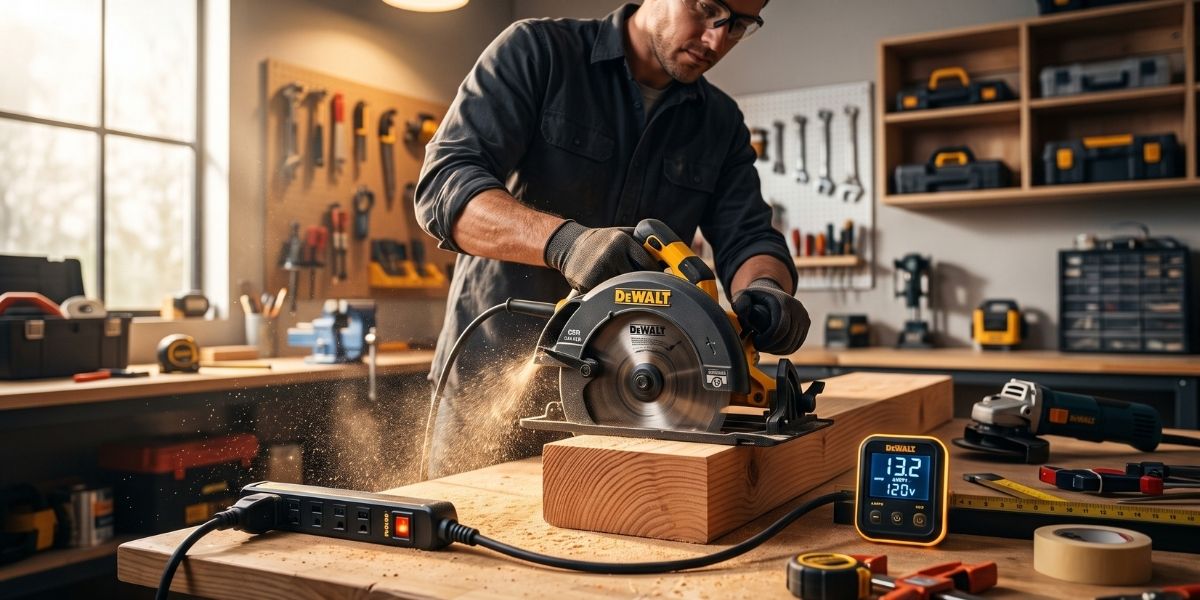
For example, a circular saw blade guard helps cover the blade when the saw is not actively cutting. An angle grinder guard helps shield the user from sparks, debris, and possible wheel breakage. A table saw guard helps reduce direct contact with the blade. A miter saw guard covers the blade as it moves up and down.
OSHA states that when power-operated tools are designed to accommodate guards, they must be equipped with those guards when in use. CCOHS also advises users to make sure the power tool has the correct guard, shield, or attachment recommended by the manufacturer.
Do not treat guards as optional. If the guard is missing, damaged, loose, or not returning properly, stop and fix the issue before using the tool.
Never Engage the Trigger Lock While Carrying or Adjusting a Tool
Many power tools have a trigger lock or lock-on switch. This feature allows the tool to keep running without the user continuously holding the trigger. It can be useful for some long operations, but it can also be dangerous if used at the wrong time.
Never engage the trigger lock while carrying, adjusting, plugging in, cleaning, or changing accessories on a tool.
A locked trigger can cause accidental startup. This is especially dangerous with saws, grinders, drills, routers, sanders, and other tools with fast-moving parts. If the tool starts while your hand is near the blade, bit, or disc, the result can be serious injury.
Before plugging in a corded tool or inserting a battery into a cordless tool, check that the switch is off. Do not carry a tool with your finger on the trigger. Do not walk around with the lock-on switch engaged. Do not change blades, bits, sanding pads, or grinder discs while the tool is connected to power.
OSHA’s hand and power tool guidance says tools should be disconnected when not in use, before servicing and cleaning, and when changing accessories such as blades, bits, and cutters.
This is one of the best habits you can build: power off, unplug, remove battery, then adjust.
Never Engage a Damaged Power Tool
A damaged tool should never be used. Even if it still turns on, it may not be safe.
Never engage a power tool that has a cracked housing, broken switch, burning smell, loose part, missing guard, damaged cord, unusual noise, or excessive vibration.
Power tools operate under speed, force, heat, and electrical load. A small defect can become worse during use. A loose blade can fly off. A cracked grinder disc can break apart. A faulty switch can fail to shut the tool off. A damaged motor can overheat. A broken housing can expose the user to electrical or mechanical hazards.
Warning signs include a damaged cord, loose blade or bit, broken switch, missing guard, worn brushes, overheating, smoke, sparks from the motor area, strange grinding sounds, or a tool that vibrates more than normal.
OSHA recommends removing damaged portable electric tools from use and tagging them “Do Not Use.” This is a strong safety rule for both workplaces and home workshops. If a tool is damaged, do not test your luck. Remove it from service until it is repaired or replaced.
A good user does not ask, “Can I finish one more cut with this?” A safe user asks, “What happens if this fails while I am using it?”
Never Engage a Power Tool With a Damaged Cord or Plug
A damaged cord is not a minor problem. It can cause electric shock, burns, sparks, fire, or tool failure.
Never engage a corded power tool if the cord or plug is damaged.
Look for cuts, cracks, exposed wires, melted insulation, bent plug blades, loose connections, or tape covering old damage. Electrical tape is not a proper permanent repair for serious cord damage. If the cord is damaged, the tool should be removed from use and repaired correctly.
Do not pull a plug from the outlet by yanking the cord. Do not carry a tool by its cord. Do not run cords through water, across sharp edges, under heavy materials, or through areas where they can be crushed.
Extension cords also matter. The wrong extension cord can overheat, reduce tool performance, or create a fire risk. Outdoor work requires extension cords rated for outdoor use. The cord must also be the proper gauge for the tool’s power demand and cord length.
CCOHS advises users to use approved extension cords with the proper wire size for the cord length and the power requirements of the tool. OSHA also warns that damaged cords can expose users to serious electrical shock.
If you are working outside, in a garage, on a construction site, or near damp floors, be extra careful. Water and damaged cords are a dangerous combination.
Never Engage the Wrong Blade, Bit, Disc, or Accessory
Every blade, bit, wheel, disc, and accessory is made for a specific type of tool, material, speed, and job. Using the wrong accessory can cause kickback, breakage, overheating, poor cuts, and serious injury.
Never engage a power tool with the wrong blade, bit, disc, or accessory installed.
A wood-cutting blade should not be used on metal unless it is specifically designed for that purpose. A grinder disc should match the grinder type, size, and RPM rating. A drill bit should match the material being drilled. A cutting wheel should not be used for side grinding unless the manufacturer says it is designed for that use.
One of the most important things to check is the accessory’s RPM rating. The accessory must be rated for the speed of the tool. If a wheel, disc, or blade spins faster than it was designed to handle, it can break apart.
Damaged accessories should also be avoided. Do not use cracked cutting wheels, bent saw blades, dull bits, worn sanding pads, or chipped router bits. A dull or damaged accessory often makes the user push harder, which increases risk.
Before starting, ask three questions: Is this accessory made for this tool? Is it made for this material? Is it in safe condition?
If the answer is no, do not engage the tool.
Never Engage a Power Tool Before Securing the Workpiece
A loose workpiece can shift, spin, bind, jump, or kick back. This is why clamping and support are essential.
Never engage a power tool before securing the workpiece.
Many beginners try to hold material with one hand and operate the tool with the other. This is especially risky with small pieces of wood, metal, plastic, pipe, or sheet material. If the bit catches or the blade binds, the workpiece can move suddenly. Your hand may also move toward the cutting area.
Use clamps, vises, sawhorses, bench dogs, stable tables, or other proper supports. A secured workpiece allows better control and keeps both hands in safer positions.
This is important when drilling, sawing, routing, grinding, sanding, and cutting. Even a small piece can become dangerous if it rotates around a drill bit or catches on a saw blade.
The goal is simple: the tool should move only how you intend, and the material should stay where you placed it.
Before turning on the tool, push the workpiece gently. If it moves, slides, rocks, tips, or vibrates, secure it better.
Never Engage Power Tools While Wearing Loose Clothing or Jewelry
Loose clothing and jewelry can get caught in moving parts. Once fabric, hair, or jewelry is pulled into a rotating tool, the user may not have time to react.
Never engage power tools while wearing loose sleeves, necklaces, bracelets, dangling drawstrings, loose gloves near rotating parts, or long hair that is not tied back.
This rule is especially important for drills, lathes, grinders, saws, routers, sanders, and any tool with a spinning shaft, blade, bit, wheel, or chuck.
Loose gloves can also be dangerous around rotating equipment. Gloves may protect hands from sharp material or heat in some tasks, but they can become a catch hazard near spinning parts. Choose PPE based on the tool and the job.
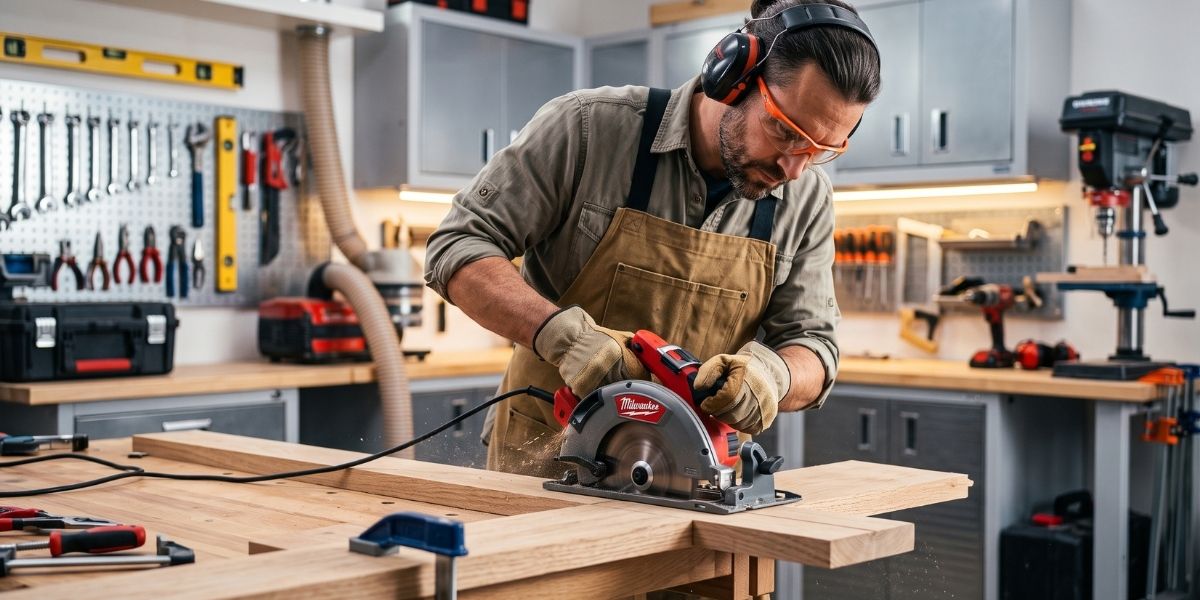
Wear fitted clothing. Remove jewelry. Tie back long hair. Avoid hoodie strings, loose cuffs, and hanging accessories. Keep your body clear of the tool’s moving path.
Power tool safety is not only about the tool. It is also about what you bring near the tool.
Never Engage Power Tools Without Proper Eye and Ear Protection
Power tools can throw dust, chips, sparks, splinters, metal fragments, and broken accessory pieces. They can also create noise levels that damage hearing over time.
Never engage power tools without proper eye protection, and use hearing protection when the tool or environment is loud.
Safety glasses or goggles should be used for most cutting, drilling, grinding, sanding, and fastening jobs. For grinding, heavy cutting, or work with flying debris, a face shield may be needed in addition to safety glasses. A face shield alone may not fully replace eye protection, so follow manufacturer and workplace guidance.
Hearing protection is also important. Many people ignore noise because hearing damage is often gradual. A tool may not hurt your ears immediately, but repeated exposure can still cause long-term problems.
Dust protection matters too. Cutting wood, sanding paint, grinding masonry, or drilling concrete can create dust that should not be inhaled. Use a dust mask, respirator, dust collection system, or ventilation when needed.
CCOHS lists PPE options for electric power tool use, including safety glasses or goggles, face shields, hearing protection, respiratory protection, gloves, safety boots, and appropriate footwear depending on the work.
The right protection depends on the tool, material, and environment. But the basic rule remains: do not wait until debris hits your face to start wearing eye protection.
Never Engage a Power Tool in a Wet or Unsafe Environment
Water and electricity do not mix. Wet conditions increase the risk of electric shock, slipping, tool damage, and poor control.
Never engage a power tool in a wet or unsafe environment unless the tool, power supply, and safety protections are specifically designed for that condition.
Avoid using corded power tools in rain, standing water, wet floors, or damp areas. Do not place cords in puddles. Do not touch plugs, outlets, or switches with wet hands. If a power tool falls into water, do not grab it while it is still connected to power. OSHA warns that users should disconnect the power source before reacting to a tool dropped into water.
Poor lighting is another unsafe condition. If you cannot clearly see the blade, bit, cut line, cord, clamp, or workpiece, do not start. Shadows and clutter can hide hazards.
Also watch for flammable liquids, gases, sawdust buildup, and sparks. Grinders and saws can produce sparks that may ignite nearby materials. Keep the area clean and remove fire hazards before working.
A safe work area should be dry, clean, stable, and well-lit. Good lighting and clean floors may seem simple, but they reduce mistakes and improve control.
Never Engage a Tool Before Reading the Manual
Every power tool has limits. The manual explains those limits.
Never engage a tool you do not understand.
Even if you have used similar tools before, different models can have different controls, guards, blade changes, speed settings, battery systems, depth adjustments, safety locks, and accessory requirements. Guessing is not a safe operating method.
The manual tells you what the tool is designed to do, what it should not be used for, what accessories are approved, how to install parts, how to adjust guards, and how to maintain the tool. It may also explain specific hazards such as kickback, binding, overheating, dust exposure, or battery safety.
Reading the manual does not make you inexperienced. It makes you careful.
This is especially important when using routers, table saws, angle grinders, nailers, planers, chainsaws, rotary tools, demolition hammers, and high-torque drills. These tools can react strongly if used incorrectly.
Before using a new tool, learn the switch, lock, guard, accessory system, speed control, and shutdown process. You should know how to stop the tool before you start it.
Never Engage Power Tools When Distracted, Tired, or Rushed
Power tools require attention. A moment of distraction can move your hand, shift the tool, or cause you to miss a warning sign.
Never engage power tools when you are distracted, tired, rushed, angry, impaired, or unable to focus.
Do not use a power tool while looking at your phone, talking casually, listening to distracting audio, or thinking about something else. Do not work when you are too tired to maintain control. Fatigue slows reaction time and increases mistakes.
Rushing is another common danger. Many accidents happen when users think, “This will only take a second.” They skip clamps, ignore guards, forget eye protection, or make a quick cut without planning the tool path.
Alcohol, drugs, and impairing medication should never be mixed with power tool use. Even if you feel normal, your coordination and judgment may be affected.
A focused user notices when the blade binds, the motor changes sound, the material shifts, or the tool starts to vibrate. A distracted user may notice too late.
If you are not mentally ready, do not engage the tool.
Never Engage Excessive Force
A power tool should cut, drill, grind, or sand with controlled pressure. If you have to force it aggressively, something is wrong.
Never engage excessive force when using a power tool.
Forcing a tool can damage the motor, break accessories, burn material, reduce accuracy, and increase kickback. A sharp blade, correct bit, proper speed, and steady technique should do most of the work.
For example, forcing a drill through metal can break the bit or spin the workpiece. Pushing a circular saw too fast can bind the blade. Pressing too hard with a grinder can overheat the disc or reduce control. Using a dull blade can make the tool work harder and increase the chance of kickback.
If the tool struggles, stop and check the cause. Is the blade dull? Is the bit wrong? Is the speed setting too high or too low? Is the material properly supported? Is the cut closing on the blade? Is the accessory damaged?
Good technique is controlled, not aggressive. Let the tool work at the pace it was designed for.
Never Engage the Tool Until the Blade or Bit Is Clear
Many power tools need space to start safely. If the blade, bit, disc, or wheel is jammed, touching the wrong area, or trapped in the material, startup can cause sudden movement.
Never engage the tool until the blade or bit is clear and positioned correctly.
Some tools should reach full speed before contacting the material. This is common with circular saws, angle grinders, routers, and some cutting tools. Starting with the blade buried or jammed can cause kickback or loss of control.
For a circular saw, make sure the blade is not touching the workpiece before the tool reaches speed, unless the tool instructions say otherwise. For a grinder, allow the wheel to reach operating speed before applying it to the work. OSHA guidance for portable grinders advises allowing the tool to come up to operating speed before grinding or cutting.
For drills, make sure the bit is straight and properly seated. For jigsaws, make sure the blade is not bent or trapped. For routers, make sure the bit is clear and the base is stable before startup.
The startup moment matters. A tool that starts under stress can jump, twist, or kick back.
Never Engage Power Tools Near Children, Pets, or Untrained People
Power tool work needs a clear safety zone. Bystanders can be injured by flying debris, sparks, dust, noise, falling materials, or accidental contact.
Never engage power tools near children, pets, or untrained people.
Children and pets do not understand tool hazards. They may walk behind you, touch cords, bump the workbench, pick up sharp pieces, or step into the cutting area. Even a short distraction can be dangerous.
Untrained adults can also create risk if they stand too close, hold material incorrectly, distract the operator, or reach near the tool path.
Before starting, create a clear work zone. Ask others to stay back. Keep children and pets out of the room, garage, yard, or work area. Use barriers if necessary. Make sure cords are not stretched across walkways.
A safe operator controls not only the tool, but also the space around the tool.
Never Engage a Power Tool Without Checking the Power Source
A tool is only as safe as the power source behind it. Wrong voltage, overloaded outlets, weak batteries, poor chargers, and undersized extension cords can all create problems.
Never engage a power tool without checking the power source.
For corded tools, make sure the outlet, voltage, plug, and extension cord match the tool’s requirements. Do not overload power strips. Do not connect high-amp tools to weak or damaged extension cords. Do not use indoor cords outdoors.
For cordless tools, use the correct battery and charger recommended by the manufacturer. Do not force incompatible batteries. Do not use damaged batteries, swollen battery packs, cracked chargers, or batteries that overheat. If the battery does not lock properly into the tool, do not use it.
Weak batteries can also affect tool performance. A struggling cordless tool may stall, bind, or behave unpredictably under load. Charge and inspect batteries before use.
Before turning the tool on, confirm that the power source is stable, correct, and safe.
Common Mistakes People Make When Using Power Tools
Many power tool mistakes are common because they seem small. But small mistakes can lead to serious injuries.
One common mistake is using dull blades. A dull blade does not just cut poorly; it also makes the user push harder. That extra force can cause slipping, binding, overheating, and kickback.
Another mistake is removing safety guards. Some users think they have enough experience to work without guards. Experience does not stop a broken disc, sudden kickback, or accidental contact.
Ignoring strange sounds is also risky. If a tool suddenly sounds different, vibrates heavily, smells hot, or sparks abnormally, stop using it. The tool may be warning you before it fails.
Holding material by hand instead of clamping it is another common problem. A workpiece can move faster than your hand can react. Clamps are not just for convenience; they are part of safe control.
Other mistakes include wearing loose clothing, using the wrong accessory, forgetting eye protection, leaving tools plugged in during blade changes, working too fast, and not cleaning the work area.
Most of these mistakes come from overconfidence. The safest users are not the ones who rush. They are the ones who repeat basic safety checks every time.
Quick Safety Checklist Before Using Any Power Tool
Before using any power tool, take a few seconds to check the basics.
Make sure the tool is clean and undamaged. Check the cord, plug, battery, charger, switch, housing, and guard. Confirm that the correct blade, bit, disc, wheel, or accessory is installed. Make sure it is tight, undamaged, and rated for the tool.
Check that the safety guard is in place and working. Secure the workpiece with clamps or proper support. Put on the right PPE, such as safety glasses, hearing protection, dust protection, gloves, or safety footwear depending on the task.
Look at the work area. It should be dry, clean, stable, and well-lit. Remove clutter, flammable materials, and tripping hazards. Keep children, pets, and bystanders away.
Check yourself too. Are you focused? Are you tired? Are your sleeves loose? Is your jewelry removed? Is your hair tied back? Do you understand the tool controls?
Finally, test the tool briefly before full use. Listen for unusual sounds. Watch for vibration. Make sure the tool starts and stops correctly.
This checklist may take less than a minute, but it can prevent a serious accident.
Final Thoughts
Power tool safety begins before the tool starts. The most important question is not only “How do I use this tool?” It is also “What should I never engage while using this tool?”
Never engage damaged tools, disabled guards, wrong accessories, trigger locks during handling, loose clothing, distractions, unstable workpieces, wet environments, or any tool feature you do not understand.
A power tool should be used only when the tool is ready, the material is secure, the user is focused, and the work area is safe. If something feels wrong, stop. Inspect the tool. Read the manual. Change the accessory. Clamp the material. Put on the right protection. Move bystanders away. Fix the problem before continuing.
Power tools can save time, improve accuracy, and make difficult work easier. But they must be used with care. A few seconds of checking can protect your hands, eyes, hearing, and life.
The safest habit is simple: never engage the tool until everything around it is ready.