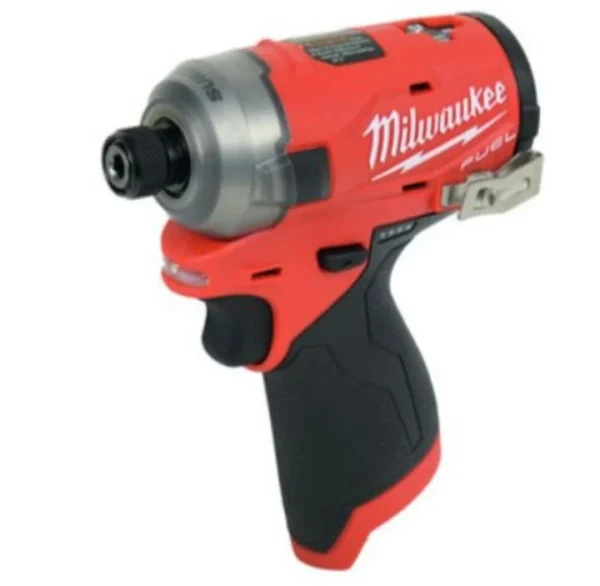


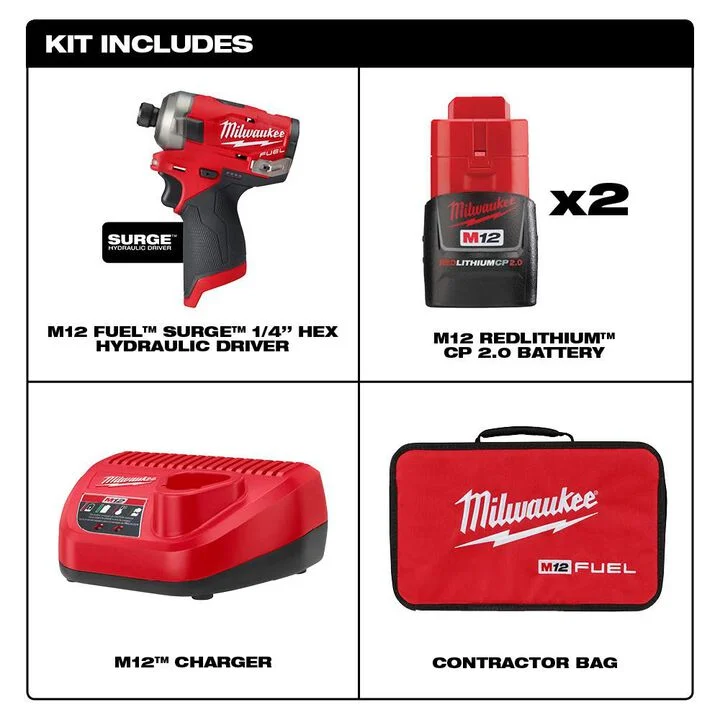




Milwaukee M12 FUEL SURGE 1/4 in. Hex Hydraulic Driver 2 Battery Kit
$199.00
Features
- Longer sustained torque delivers similar drive times in application as most 12V impact drivers
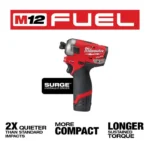
- Up to 2X quieter operation makes this tool ideal for occupied spaces
- Compact head length and compact battery footprint gives more access than competitive impact drivers
- POWERSTATE™ brushless motor delivers maximum power and long motor life
- REDLINK Plus™ intelligence prevents damage to the tool and battery due to overloading or overheating
- REDLITHIUM™ batteries deliver more work per charge and more work over the life of the battery
Milwaukee M12 Surge vs Fuel: The Ultimate Deep-Dive Comparison Guide for Power Tool Users
Introduction: Understanding the Milwaukee M12 Surge vs Fuel Debate
The debate around milwaukee m12 surge vs fuel has become one of the most discussed topics in the compact power tool world. Whether you’re a professional tradesperson or a DIY enthusiast, choosing between these two Milwaukee impact driver technologies can significantly affect your workflow, comfort, and precision.
At first glance, both tools appear similar. They are part of Milwaukee’s M12 platform, both deliver compact performance, and both are designed for fastening tasks. However, under the hood, they operate in fundamentally different ways. The Milwaukee M12 FUEL SURGE hydraulic impact driver uses a hydraulic “oil impulse” system, while the standard M12 FUEL impact driver relies on a traditional hammer-and-anvil mechanism.
This difference creates a ripple effect across noise levels, torque delivery, vibration, and user experience. In this guide, we break down everything you need to know, including deep comparisons, model insights like the milwaukee 2551-20 m12 fuel surge hex hydraulic driver, and real-world performance analysis so you can confidently decide which tool fits your needs.
H1: Milwaukee M12 Surge vs Fuel – Core Differences Explained
Understanding the milwaukee m12 surge vs fuel comparison starts with the fundamental engineering behind each tool. Both are impact drivers, but they deliver force differently.
The M12 Fuel Impact Driver (standard) uses a mechanical impact system that produces high peak torque. It is loud, aggressive, and designed for maximum fastening power.
On the other hand, the M12 Fuel Surge uses Milwaukee’s FLUID-DRIVE hydraulic powertrain, which replaces the metal-on-metal impact system with hydraulic pressure. This results in smoother operation, reduced vibration, and significantly quieter performance.
According to Milwaukee’s official product data, the Surge operates up to 2X quieter than standard impact drivers, making it ideal for indoor work, occupied spaces, and precision fastening tasks.
This alone creates a clear separation between the two tools, but there’s much more to explore.
H2: Milwaukee M12 Fuel Surge Hydraulic Impact Driver Technology
The milwaukee m12 fuel surge hydraulic impact drive is one of the most innovative compact tools Milwaukee has ever produced. Instead of hammering metal components together, it uses a sealed hydraulic chamber filled with fluid.
H3: How the Hydraulic System Works
Inside the tool, fluid replaces traditional mechanical impacts. When resistance is detected, hydraulic pressure absorbs and redistributes force more smoothly. This reduces vibration significantly and creates a more controlled driving experience.
H3: Real-World Benefits of Hydraulic Drive
- Noticeably quieter operation
- Reduced hand fatigue
- Less screw stripping
- Improved control in delicate materials
- Better performance in enclosed environments
Users often describe it as “driving screws instead of hammering them,” which is a very accurate analogy.
H2: Milwaukee M12 FUEL Impact Driver (Standard Model) Overview
The standard M12 Fuel impact driver is the more traditional and aggressive option in this comparison. It uses a high-speed motor combined with a hammer-and-anvil system that delivers repeated impacts per second.
H3: Performance Characteristics
- Higher peak torque output (up to ~1300 in-lbs in newer models)
- Faster fastening speed in heavy-duty applications
- More suitable for construction framing and lag bolts
- Lighter weight compared to Surge models
H3: Who It’s Designed For
This tool is built for users who prioritize raw power and speed over comfort and silence. If you’re working on decks, framing, or large fasteners, this is typically the better choice.
H2: Milwaukee 2551-20 M12 Fuel Surge Hex Hydraulic Driver Breakdown
The milwaukee 2551-20 m12 fuel surge hex hydraulic driver is the most recognized model in the Surge lineup. It represents Milwaukee’s first 12V hydraulic impact driver.
H3: Key Specifications
- Voltage: 12V M12 system
- Drive Type: 1/4″ Hex
- System: FLUID-DRIVE hydraulic mechanism
- Speed: up to 3,200 RPM
- Noise: up to 2X quieter than standard impacts
H3: Performance Advantages
This model excels in:
- Electrical installations
- Cabinet assembly
- HVAC fastening work
- Indoor renovation tasks
It is widely praised for its balance between power and finesse, making it one of Milwaukee’s most versatile compact drivers.
H2: Milwaukee M12 Fuel Surge 1/4 Hex Hydraulic Driver in Real Use
The milwaukee m12 fuel surge 1/4 hex hydraulic driver has become especially popular among electricians and interior contractors.
H3: Why Professionals Prefer It
The main appeal lies in its smooth driving experience. Instead of jerky bursts of torque, the Surge delivers steady rotational force, which is ideal for:
- Drywall screws
- Electrical boxes
- Light metal framing
- Finish carpentry
H3: Limitations You Should Know
Despite its advantages, the Surge has limitations:
- Lower peak torque than Fuel models
- Slower in heavy-duty fastening
- Not ideal for large lag bolts or structural work
Still, many professionals consider it their “daily driver” tool.
H2: Head-to-Head Comparison – Milwaukee M12 Surge vs Fuel
Let’s break down the real differences clearly.
| Feature | M12 Fuel Impact Driver | M12 Surge Hydraulic Driver |
|---|---|---|
| Torque Output | Higher (~1300 in-lbs) | Lower (~450 in-lbs) |
| Noise Level | Loud | Very quiet |
| Vibration | High | Low |
| Control | Aggressive | Precise |
| Best Use | Heavy-duty fastening | Precision & indoor work |
| Weight | Lighter | Slightly heavier |
The contrast is clear: Fuel = power, Surge = control.
H2: Milwaukee M12 Fuel Surge Impact Driverx vs Traditional Impact Drivers
The term milwaukee m12 fuel surge impact driverx often refers to upgraded or bundled configurations of the Surge system. Regardless of naming variations, the performance philosophy remains the same.
H3: Key Differentiator
The Surge is not trying to outperform traditional impacts in raw power. Instead, it focuses on:
- Reducing user fatigue
- Improving precision
- Enhancing comfort over long usage
This makes it a niche but highly valuable tool in the Milwaukee ecosystem.
H2: Noise, Comfort, and Ergonomics Comparison
One of the biggest reasons users choose the Surge is comfort.
H3: Noise Difference
The standard Fuel impact driver sounds like rapid machine gun bursts. The Surge, however, sounds more like a controlled electric screwdriver.
This is why many users describe it as:
- “Office-friendly impact driver”
- “Quiet revolution tool”
H3: Vibration Control
Hydraulic technology dramatically reduces vibration, making long sessions less tiring.
This is especially useful for:
- Ceiling work
- Overhead fastening
- Repetitive screw driving
H2: Milwaukee M12 Fuel Surge vs Fuel for DIY Users
If you’re a homeowner or DIY user, the decision becomes more interesting.
H3: Why Surge Wins for DIY
- Quieter operation indoors
- Easier control for beginners
- Less risk of overdriving screws
H3: Why Fuel Still Matters
- Better for deck building
- Faster for large projects
- More universal power range
For most DIY users, the Surge feels more “friendly” and forgiving.
H2: Professional Contractor Perspective
On job sites, preferences split clearly.
H3: Surge Users Say
- It’s perfect for finish work
- Less fatigue during long shifts
- Better for precision installs
H3: Fuel Users Say
- It handles everything
- No need to switch tools
- Better for demanding materials
Some professionals carry both for maximum flexibility.
H2: Is the Milwaukee M12 Fuel Surge Worth It?
Yes—but only if your use case matches its strengths.
H3: Choose Surge If You Want
- Quiet operation
- Smooth driving
- Interior-focused work
- Reduced vibration
H3: Choose Fuel If You Want
- Maximum power
- Fast driving speed
- Outdoor construction capability
H2: Final Verdict – Milwaukee M12 Surge vs Fuel
The milwaukee m12 surge vs fuel comparison is not about which tool is better universally—it’s about which tool fits your workflow.
If you want brute strength, speed, and jobsite dominance, the M12 Fuel Impact Driver is your best bet.
If you want comfort, precision, and quiet operation, the M12 Fuel Surge Hydraulic Driver is unmatched in its category.
Both tools are excellent, but they serve different philosophies: one is a hammer, the other is a scalpel.
Conclusion
The Milwaukee ecosystem gives users a rare choice between two advanced impact technologies. The milwaukee m12 fuel surge hydraulic impact drive represents innovation through control and comfort, while the traditional Fuel impact driver represents raw mechanical power and speed.
Understanding this difference allows you to pick the right tool instead of simply choosing the most powerful one. In many cases, professionals eventually end up owning both because each fills a specific gap in performance.
Milwaukee M12 Surge vs Fuel: The Ultimate Deep-Dive Comparison Guide for Power Tool Users
Introduction: Understanding the Milwaukee M12 Surge vs Fuel Debate
The debate around milwaukee m12 surge vs fuel has become one of the most discussed topics in the compact power tool world. Whether you’re a professional tradesperson or a DIY enthusiast, choosing between these two Milwaukee impact driver technologies can significantly affect your workflow, comfort, and precision.
At first glance, both tools appear similar. They are part of Milwaukee’s M12 platform, both deliver compact performance, and both are designed for fastening tasks. However, under the hood, they operate in fundamentally different ways. The Milwaukee M12 FUEL SURGE hydraulic impact driver uses a hydraulic “oil impulse” system, while the standard M12 FUEL impact driver relies on a traditional hammer-and-anvil mechanism.
This difference creates a ripple effect across noise levels, torque delivery, vibration, and user experience. In this guide, we break down everything you need to know, including deep comparisons, model insights like the milwaukee 2551-20 m12 fuel surge hex hydraulic driver, and real-world performance analysis so you can confidently decide which tool fits your needs.
H1: Milwaukee M12 Surge vs Fuel – Core Differences Explained
Understanding the milwaukee m12 surge vs fuel comparison starts with the fundamental engineering behind each tool. Both are impact drivers, but they deliver force differently.
The M12 Fuel Impact Driver (standard) uses a mechanical impact system that produces high peak torque. It is loud, aggressive, and designed for maximum fastening power.
On the other hand, the M12 Fuel Surge uses Milwaukee’s FLUID-DRIVE hydraulic powertrain, which replaces the metal-on-metal impact system with hydraulic pressure. This results in smoother operation, reduced vibration, and significantly quieter performance.
According to Milwaukee’s official product data, the Surge operates up to 2X quieter than standard impact drivers, making it ideal for indoor work, occupied spaces, and precision fastening tasks.
This alone creates a clear separation between the two tools, but there’s much more to explore.
H2: Milwaukee M12 Fuel Surge Hydraulic Impact Driver Technology
The milwaukee m12 fuel surge hydraulic impact drive is one of the most innovative compact tools Milwaukee has ever produced. Instead of hammering metal components together, it uses a sealed hydraulic chamber filled with fluid.
H3: How the Hydraulic System Works
Inside the tool, fluid replaces traditional mechanical impacts. When resistance is detected, hydraulic pressure absorbs and redistributes force more smoothly. This reduces vibration significantly and creates a more controlled driving experience.
H3: Real-World Benefits of Hydraulic Drive
- Noticeably quieter operation
- Reduced hand fatigue
- Less screw stripping
- Improved control in delicate materials
- Better performance in enclosed environments
Users often describe it as “driving screws instead of hammering them,” which is a very accurate analogy.
H2: Milwaukee M12 FUEL Impact Driver (Standard Model) Overview
The standard M12 Fuel impact driver is the more traditional and aggressive option in this comparison. It uses a high-speed motor combined with a hammer-and-anvil system that delivers repeated impacts per second.
H3: Performance Characteristics
- Higher peak torque output (up to ~1300 in-lbs in newer models)
- Faster fastening speed in heavy-duty applications
- More suitable for construction framing and lag bolts
- Lighter weight compared to Surge models
H3: Who It’s Designed For
This tool is built for users who prioritize raw power and speed over comfort and silence. If you’re working on decks, framing, or large fasteners, this is typically the better choice.
H2: Milwaukee 2551-20 M12 Fuel Surge Hex Hydraulic Driver Breakdown
The milwaukee 2551-20 m12 fuel surge hex hydraulic driver is the most recognized model in the Surge lineup. It represents Milwaukee’s first 12V hydraulic impact driver.
H3: Key Specifications
- Voltage: 12V M12 system
- Drive Type: 1/4″ Hex
- System: FLUID-DRIVE hydraulic mechanism
- Speed: up to 3,200 RPM
- Noise: up to 2X quieter than standard impacts
H3: Performance Advantages
This model excels in:
- Electrical installations
- Cabinet assembly
- HVAC fastening work
- Indoor renovation tasks
It is widely praised for its balance between power and finesse, making it one of Milwaukee’s most versatile compact drivers.
H2: Milwaukee M12 Fuel Surge 1/4 Hex Hydraulic Driver in Real Use
The milwaukee m12 fuel surge 1/4 hex hydraulic driver has become especially popular among electricians and interior contractors.
H3: Why Professionals Prefer It
The main appeal lies in its smooth driving experience. Instead of jerky bursts of torque, the Surge delivers steady rotational force, which is ideal for:
- Drywall screws
- Electrical boxes
- Light metal framing
- Finish carpentry
H3: Limitations You Should Know
Despite its advantages, the Surge has limitations:
- Lower peak torque than Fuel models
- Slower in heavy-duty fastening
- Not ideal for large lag bolts or structural work
Still, many professionals consider it their “daily driver” tool.
H2: Head-to-Head Comparison – Milwaukee M12 Surge vs Fuel
Let’s break down the real differences clearly.
| Feature | M12 Fuel Impact Driver | M12 Surge Hydraulic Driver |
|---|---|---|
| Torque Output | Higher (~1300 in-lbs) | Lower (~450 in-lbs) |
| Noise Level | Loud | Very quiet |
| Vibration | High | Low |
| Control | Aggressive | Precise |
| Best Use | Heavy-duty fastening | Precision & indoor work |
| Weight | Lighter | Slightly heavier |
The contrast is clear: Fuel = power, Surge = control.
H2: Milwaukee M12 Fuel Surge Impact Driverx vs Traditional Impact Drivers
The term milwaukee m12 fuel surge impact driverx often refers to upgraded or bundled configurations of the Surge system. Regardless of naming variations, the performance philosophy remains the same.
H3: Key Differentiator
The Surge is not trying to outperform traditional impacts in raw power. Instead, it focuses on:
- Reducing user fatigue
- Improving precision
- Enhancing comfort over long usage
This makes it a niche but highly valuable tool in the Milwaukee ecosystem.
H2: Noise, Comfort, and Ergonomics Comparison
One of the biggest reasons users choose the Surge is comfort.
H3: Noise Difference
The standard Fuel impact driver sounds like rapid machine gun bursts. The Surge, however, sounds more like a controlled electric screwdriver.
This is why many users describe it as:
- “Office-friendly impact driver”
- “Quiet revolution tool”
H3: Vibration Control
Hydraulic technology dramatically reduces vibration, making long sessions less tiring.
This is especially useful for:
- Ceiling work
- Overhead fastening
- Repetitive screw driving
H2: Milwaukee M12 Fuel Surge vs Fuel for DIY Users
If you’re a homeowner or DIY user, the decision becomes more interesting.
H3: Why Surge Wins for DIY
- Quieter operation indoors
- Easier control for beginners
- Less risk of overdriving screws
H3: Why Fuel Still Matters
- Better for deck building
- Faster for large projects
- More universal power range
For most DIY users, the Surge feels more “friendly” and forgiving.
H2: Professional Contractor Perspective
On job sites, preferences split clearly.
H3: Surge Users Say
- It’s perfect for finish work
- Less fatigue during long shifts
- Better for precision installs
H3: Fuel Users Say
- It handles everything
- No need to switch tools
- Better for demanding materials
Some professionals carry both for maximum flexibility.
H2: Is the Milwaukee M12 Fuel Surge Worth It?
Yes—but only if your use case matches its strengths.
H3: Choose Surge If You Want
- Quiet operation
- Smooth driving
- Interior-focused work
- Reduced vibration
H3: Choose Fuel If You Want
- Maximum power
- Fast driving speed
- Outdoor construction capability
H2: Final Verdict – Milwaukee M12 Surge vs Fuel
The milwaukee m12 surge vs fuel comparison is not about which tool is better universally—it’s about which tool fits your workflow.
If you want brute strength, speed, and jobsite dominance, the M12 Fuel Impact Driver is your best bet.
If you want comfort, precision, and quiet operation, the M12 Fuel Surge Hydraulic Driver is unmatched in its category.
Both tools are excellent, but they serve different philosophies: one is a hammer, the other is a scalpel.
Conclusion
The Milwaukee ecosystem gives users a rare choice between two advanced impact technologies. The milwaukee m12 fuel surge hydraulic impact drive represents innovation through control and comfort, while the traditional Fuel impact driver represents raw mechanical power and speed.
Understanding this difference allows you to pick the right tool instead of simply choosing the most powerful one. In many cases, professionals eventually end up owning both because each fills a specific gap in performance.